
USFans Warehouse: Check Each Item Before Building the Parcel
The warehouse stage is where separate product decisions become a parcel decision. Before combining goods, make sure you know which item has arrived, which option it represents and whether an important question remains unanswered. One ready item does not make every item in the order ready.
Use the individual records rather than a broad impression that your haul is “in the warehouse.” Arrival, inspection, storage and parcel preparation describe different things. Read the current status and associated information for each item before deciding what to do next.
On this page
Organise by item, not just by shopping session
If you selected several products together, they may still have separate records and questions. Keep each product reference attached to the chosen option, arrival information and any QC images. That prevents a picture or measurement from being applied to a similar item by mistake.
For example, two shirts in different sizes need separate confirmation even if their thumbnails look alike. A visible label on one does not settle the other. The spreadsheet links guide helps recover what you originally selected when the option is unclear.
Do not post full item identifiers or account records in a public discussion to explain this distinction. Keep the detailed mapping private and share only the information necessary for the question.
Treat arrival and acceptance as separate decisions
An arrival record tells you about a stage reached; it does not automatically answer every product question. Examine the relevant information before treating the item as ready for onward shipment. If the selected colour is wrong or an essential measurement is still unclear, that issue remains even though the goods have arrived.
The QC guide explains how to ask for a useful view, while the size guide distinguishes labels from dimensions. Avoid requesting a general recheck when you can name the exact discrepancy.
USFans's inspection scope checked on 30 September 2026 covers appearance and identifying labels, not every measurement or performance question. Electronics are not powered on as part of that inspection. Ask separately about the observation you need rather than reading an inspection status as proof of fit or function.
If a problem could change whether you want the item, discuss the available next steps before dispatch. The returns guide covers questions about product-side remedies without assuming that every case has the same outcome or deadline.
A three-item example
Imagine you are considering a parcel with a T-shirt, a pullover and a backpack. The T-shirt matches the selected option, the pullover still needs a length check and the backpack has not yet reached the recorded warehouse stage. This is an illustrative scenario, not an actual USFans order.
| Item state | Decision still needed |
|---|---|
| T-shirt appears to match | Decide whether the available information is sufficient to include it. |
| Pullover measurement unresolved | Obtain or clarify the relevant measurement before accepting that point. |
| Backpack arrival not recorded | Clarify the product's progress rather than treating it as available for packing. |
There is no single “all ready” answer until those individual decisions are addressed. You may investigate separate parcel options or decide to wait, but compare the actual consequences rather than assuming one approach is always cheaper or faster.
Examine the backpack candidate on OG
Use the backpack listing to check the candidate and option; use the actual item record to establish whether your chosen version has reached the warehouse. The listing alone does not establish warehouse availability or route acceptance.
Check the storage clock for the actual record
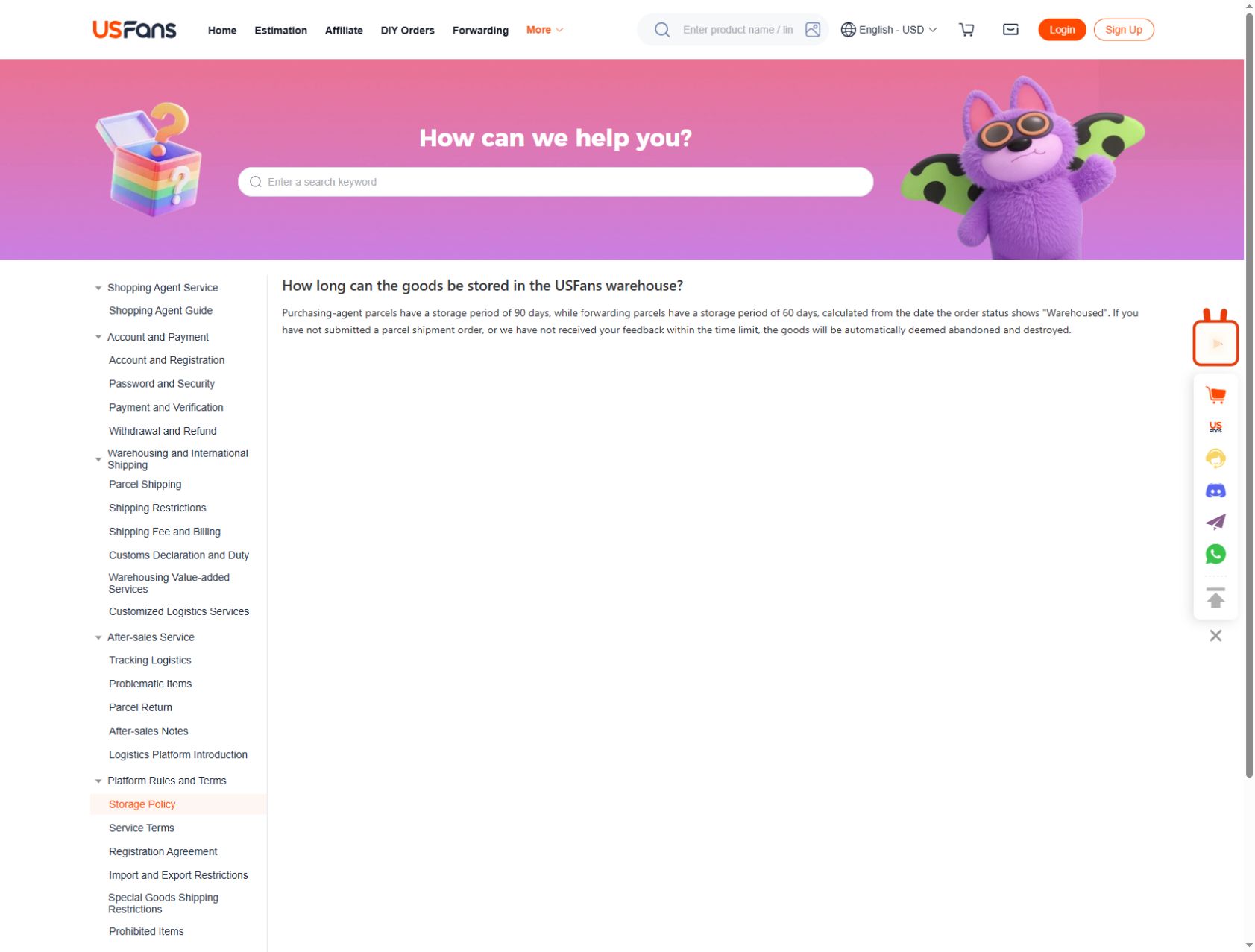
The storage policy checked on 30 September 2026 gives purchasing-agent goods a 90-day period and forwarding goods a 60-day period, counted from the Warehoused status date. It warns that goods may be treated as abandoned and destroyed if no parcel shipment order is submitted or feedback received within the limit. Note the relevant date for each item before deciding to wait for another purchase.
Do not assume that asking a question, opening a support conversation or waiting for another item automatically extends the period. Obtain a clear answer about your record if the timing is close or unclear. Keep that answer with the affected item.
A storage period is not an extension agreement. If items reached Warehoused on different dates, calculate their deadlines separately and resolve the oldest item's next step first.
Consolidation needs a parcel comparison
Combining goods is a packing decision, not an automatic discount. Consider the resulting weight, dimensions, contents and available services. Removing packaging may also change protection or presentation, so understand what a requested change actually involves.
The shipping calculator guide explains why the packed result matters. Do not estimate a combined parcel by simply adding product prices, or assume that a light item adds no shipping cost.
If you are deciding whether to wait for an outstanding item, compare the relevant parcel scenarios and storage implications. A hypothetical saving does not justify ignoring an unresolved item problem or a deadline attached to goods already present.
Do not use an internal location label as a shipping address
A city name, storage code or label in a record may help describe an internal stage without being an address you should use. Before arranging forwarding or a return, obtain the instructions appropriate to that action and account.
Do not send a package to an address copied from an old post merely because it is described as a USFans warehouse location. A destination for one type of shipment may not be suitable for another. The support guide helps you ask for the relevant instructions without guessing address details.
Keep the recipient, address and required reference together from the instructions for your transaction. An address assembled from an old post and an unrelated item record can send the goods to the wrong process even if the city looks familiar.
Move from item records to a parcel record deliberately
Before submitting a parcel, compare the selected contents with your accepted items. Check quantities and versions again. If an item has been excluded while a question is resolved, confirm that your parcel decision reflects that choice.
Once the parcel is created, keep its reference distinct from the product records. A later tracking event concerns that shipment, not necessarily every product you originally browsed. The tracking guide and delivery-time guide explain the transport-stage questions.
If a status is unclear, describe the latest recorded event and the action you expected. The order-status guide helps separate a product issue from a parcel issue. Avoid inferring loss, completed inspection or handover solely from an ambiguous label.
Common questions
Does “warehoused” mean every check is complete?
Do not infer that from the word alone. Review the associated item information and determine whether the specific checks important to you have been answered.
Should I wait for all products before shipping?
Compare your actual options, costs and timing. Waiting and splitting can have different consequences; neither is universally preferable without the relevant parcel and storage information.
Can I reuse another order's QC photo?
It may provide context about that other item, but it does not confirm the condition or option of the goods recorded for your order.
What should I ask when an item seems missing?
Identify the particular product record and last observed stage. Ask whether it has reached the warehouse record or needs another action, rather than assuming that all items from one shopping session moved together.