
Best USFans Spreadsheet: Compare the Lists Before You Compare the Finds
The best USFans spreadsheet for a purchase is the one that helps you rule out unsuitable options and recover the suitable ones. It should reduce the work between seeing a product and understanding which version you are considering. Row count, colourful thumbnails and an enthusiastic title cannot do that on their own.
Use a small, repeatable comparison before committing your attention to a collection. Choose a product need, examine several relevant entries and ask the same questions of each list. Record which list helps resolve those questions, rather than treating a prominent position or an enthusiastic label as the answer.
On this page
Define the job before opening a collection
“Find something good” gives you no useful stopping point. “Find a T-shirt with sizing information I can compare to my own clothes” is more precise. You can then judge whether a collection actually helps you make that decision.
For a broader start, the USFans spreadsheet introduction connects the categories and purchase stages. If you already know the category, start there rather than searching every row. The same collection may be clear in one section and inconsistent in another, so one attractive entry should not stand in for the whole list.
Use a consistent sample
Choose several entries relevant to your need rather than only the most prominent recommendation. Include an ordinary item as well as a featured one. If you are comparing two collections, inspect comparable types of product in both; do not compare one list's shoe section with another's accessories and call the result a general winner.
You do not need an elaborate numerical score. Record whether each entry lets you establish the following:
| Check | What you should be able to identify |
|---|---|
| Destination | The actual product reached after opening the link |
| Option | The size, colour, quantity or version under discussion |
| Price meaning | Which option and currency the displayed figure concerns |
| Image meaning | Whether the picture is a listing image or a particular item observation |
| Recovery | Enough detail to recognise the candidate when you return |
Treat an unresolved critical field as a reason for more checking, not as a small penalty that unrelated strengths can cancel out. A beautiful presentation does not compensate for being unable to identify the chosen product.
Check how a collection works on your phone
Try a short round trip: find a relevant entry, open its details, then return to the collection. Can you recognise where you left off and recover the option you were comparing? If the browsing position or filter is lost, note how much work it takes to restore it. Do not assume that a desktop-friendly table will be equally convenient on a narrow screen.
Also check whether the product name, option information and destination remain understandable together. A price visible beside the wrong row after horizontal scrolling can lead to a mistaken comparison. Product cards may be easier to scan, but cards that omit the important option details create a different problem. Choose the presentation that keeps the needed information connected, not simply the one with larger images.
Where a catalog offers search or filters, test an ordinary query that fits your purpose. Confirm that the results actually reflect the selected category. A control being visible does not demonstrate that it works; nor does an empty result prove that the product cannot exist elsewhere. Compare the response with the search input before deciding whether that tool helps your task.
If a currency selector is available, keep the currency consistent during comparison. Changing the display currency does not turn a product amount into a delivered total. Recheck the selected option and the costs included before treating two displayed prices as equivalent.
Follow the entry far enough to identify the ordering platform, without placing an order just to test a collection. Category navigation may lead to another catalogue; its buying button may then offer several agents. Check each destination and confirm USFans if that is the platform you intend to use. A USFans heading on the starting page does not settle the choice on a later screen. If a click produces no visible change, check for a new tab or an on-page chooser before repeatedly clicking. Keep any unresolved step in your notes rather than counting it as a completed handoff.
Distinguish variety from duplication
A collection can appear extensive because the same item is listed in several categories or reposted with different wording. That may be convenient navigation, but it does not necessarily give you more alternatives.
Compare the destinations and options before counting them as distinct choices. Conversely, similar photographs do not prove two entries are identical: they may differ in a detail important to you. Investigate the difference instead of declaring either duplication or variety from the thumbnail alone.
The spreadsheet links guide covers destination and option recovery. Use it when the list looks promising but the opened page does not match what you expected.
Test usefulness with one concrete candidate
Suppose you want a T-shirt. One list calls an entry a “best find” but gives no sizing context. Another describes the intended option and makes it easier to locate the relevant measurements. The second has provided more help with your actual decision, even if the first has more rows.
Examine the T-shirt candidate on OG
Check the option and compare useful dimensions with a shirt that fits you. Neither the visible branding nor an enthusiastic recommendation establishes authenticity or composition. If the measurements are missing, note the specific dimension you need rather than guessing from the photograph.
After opening the page, ask whether the collection saved meaningful work. If you still need to reconstruct the product identity and guess the option, it functioned mainly as a picture gallery. The T-shirt guide helps you turn the candidate into fit questions rather than a popularity contest.
Keep the print and size attached to the candidate
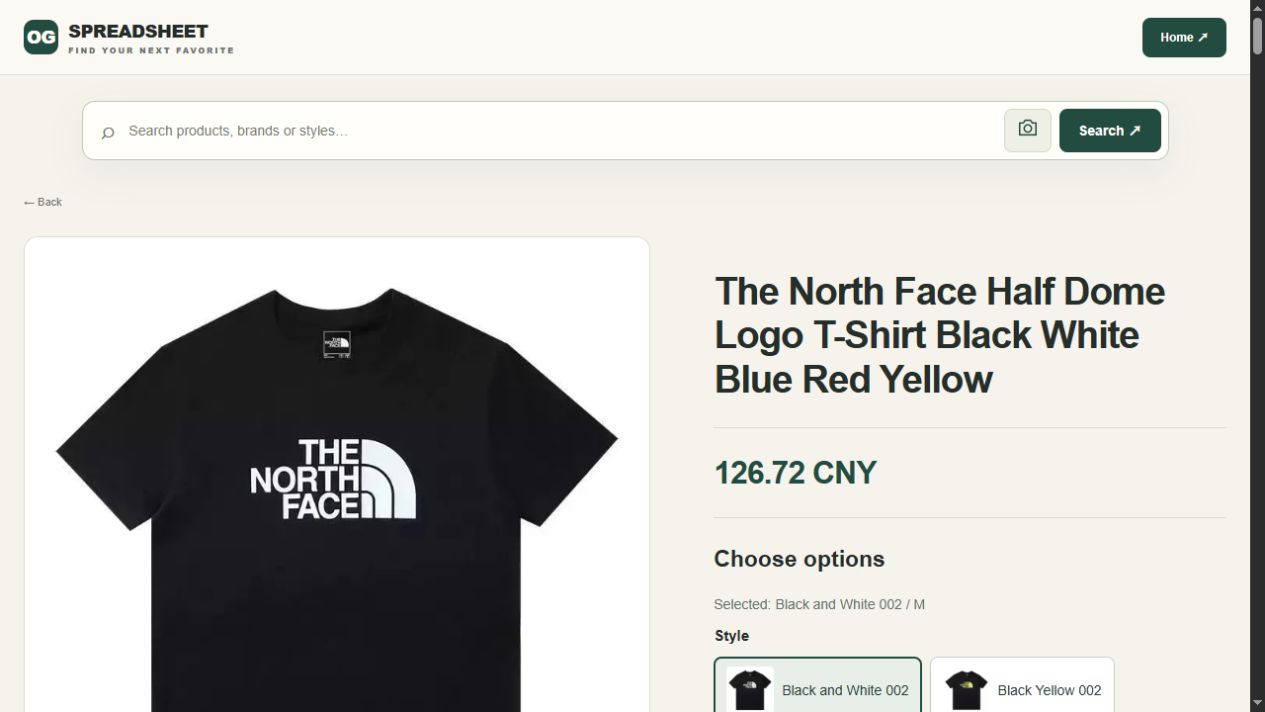
On the linked OG T-shirt reference, Black and White 002 / M displayed 126.72 CNY on 1 October 2026. The selected image showed a black short-sleeved shirt with a large white chest graphic. Its multi-colour page title did not identify that exact choice as clearly as the option text.
Use that selection to test how much work a collection saves you. A recoverable option lets you ask for the correct shirt's dimensions; an unlabelled thumbnail leaves you to reconstruct the choice first. Keep length and width as separate fit questions rather than interpreting the M label or graphic placement as measured sizing.
What makes a budget spreadsheet useful?
A USFans budget spreadsheet should support like-for-like comparisons. A low number is misleading if it belongs to an option you do not want or excludes costs you need to consider. Check the selected variant before comparing product figures, then handle parcel costs separately.
Do not describe a product as the cheapest available simply because it is the cheapest row in one list. That is a statement about the list you looked at, not the entire market. Similarly, a coupon or an old price annotation should not become a current total without checking its applicability.
The shipping calculator guide explains the inputs relevant to a parcel comparison. A useful shortlist preserves uncertainty about those costs instead of disguising it with an apparently precise basket total.
Category-specific lists need category-specific detail
For a women's spreadsheet, look beyond the category label to the selected cut and measurements. The women's clothing guide helps organise fit questions. A different category heading is not evidence that a generic size recommendation will fit your body or intended style.
For children's items, an age label alone does not answer every sizing or suitability question. Check the actual product information relevant to the intended user; do not convert an adult clothing recommendation into a children's recommendation simply by choosing the smallest option.
For an electronics spreadsheet, attractive appearance and basic identification are not enough to establish operating performance or compatibility. Determine which specification matters before accepting a recommendation. If the list supplies only a photograph, it has not answered that specification question.
These are reasons to evaluate the relevant section carefully, not to declare a whole category unsuitable. A collection should help you locate the information needed for that type of product.
Separate the curator's opinion from an observed result
“Recommended” can mean the curator likes the appearance. It may also accompany a described purchase experience. Read what the author actually claims and which option it concerns. Do not supply an unstated physical test in your own interpretation.
The QC guide explains why a photo supports some observations but not every quality claim. The spreadsheet review examines the strengths and limits of the collection format, while the safety guide addresses account and transaction questions that a product list cannot settle.
Choose, then keep the selection manageable
Prefer the collection that lets you compare relevant candidates with fewer unresolved essentials. You may use one list to discover an item and another source of product information to answer a specific question. There is no need to turn your choice of spreadsheet into a commitment to every recommendation it contains.
Retain only the candidates that meet your original need. Keep their selected options and the next question together. When the shortlist is ready, the USFans spreadsheet guide takes you through the purchase stages; an archive guide is useful when you need to revisit an older entry without mistaking its old details for current conditions.
Common questions
Does “best USFans finds” mean the products were tested?
Not by itself. Look for a specific description of what was observed or used. The wording alone does not establish a purchase, inspection or long-term test.
Is a recently edited spreadsheet automatically current?
No. A document-level update date does not show that every row was rechecked. Inspect the relevant destination and option before relying on it.
Should I reject a list with a missing measurement?
Decide whether the measurement matters to your purchase. If it would change your choice, obtain it before proceeding. Do not replace it with confidence drawn from unrelated positive details.
Can a smaller collection be better?
Yes, for a particular decision it can be easier to use if the relevant entries are clear and recoverable. That does not establish that it is better for every category or every buyer.