
USFans Spreadsheet Review: What the Collection Helps You Decide
A USFans spreadsheet can be a useful discovery tool without being a reliable answer to every purchase question. The strongest reason to use one is that it brings candidates together and makes them easier to revisit. The limitation is that a compact row can hide the difference between a recommendation, a visible detail and an actual purchase experience.
The format is useful for organising choices when its entries identify the product and option clearly. Its weaker point is the temptation to read a short recommendation as a complete purchase assessment. Judge the collection by how well it supports your selection, then handle product suitability and order costs as separate decisions.
On this page
Strength: a collection reduces repeated searching
A well-described entry lets you return to an item without reconstructing the search that found it. Categories help when you have a broad need, while a saved option helps when you have already narrowed the choice. The value is continuity: you can resume a decision instead of starting it again.
That benefit depends on more than an image. A recognisable description and a usable destination give you a way to recover the candidate. If the link reaches an unrelated page or you cannot identify the version, the collection has lost much of its practical value.
The spreadsheet links guide covers that recovery problem. For an overview of available subjects, return to the USFans spreadsheet.
Weakness: short labels can combine unrelated claims
An entry described as “great quality and fast delivery” combines at least two different observations. The writer might have liked an arrival photograph but not used the product. The delivery comment might concern another parcel, destination or period. Without context, the sentence offers confidence without a clear basis for your own decision.
Separate the claims before judging them. What quality feature was observed? Which version was involved? What event started the delivery clock? You do not need every entry to become a long review, but you need enough context to know what its summary means.
The best spreadsheet guide provides a repeatable way to compare collections. Prefer clarity on the questions that matter to you over a larger number of enthusiastic labels.
A worked review of two imaginary entries
Consider two hypothetical rows for the same zip-up jacket. Row A says “excellent jacket” beside an image and a price. Row B identifies the selected option, explains which measurement still needs checking and provides the product destination. These are invented examples of entry structure, not observations from two named collections.
Row A is quicker to scan, but its recommendation cannot be reproduced: you do not know what “excellent” evaluates or which option the price concerns. Row B is less conclusive, yet helps you decide what to do next. That is a practical advantage even before either row can support a purchase recommendation.
Now suppose Row B's link opens a different product. Its detailed wording does not rescue it. Destination accuracy is a prerequisite; extra descriptive fields cannot compensate for the wrong item. Conversely, if Row A opens the right item and its missing option can be recovered, it can still serve as a discovery entry without deserving a quality verdict.
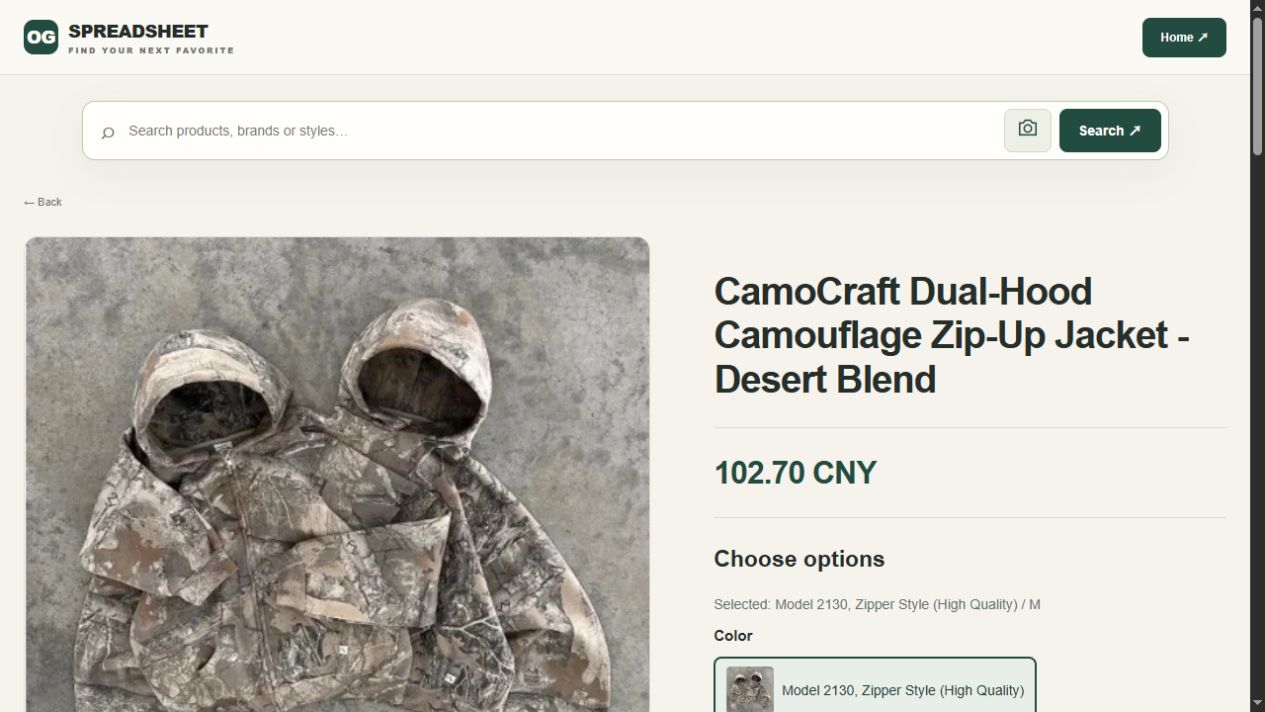
You can use this product destination to practise identifying the difference between an entry and the item it describes:
Examine the jacket details separately from a recommendation on OG
Check the selectable version and the details behind any recommendation. The name and branding do not establish composition or authenticity. For product-specific checks rather than collection assessment, continue to the jacket guide.
Three decisions that should not be averaged into one score
Swipe sideways to see all columns
| Decision | Example observation | Appropriate conclusion |
|---|---|---|
| Can I recover the candidate? | The entry reaches the intended product, but the option must be selected again. | Useful for discovery; retain the option separately. |
| Does the recommendation explain itself? | A visible detail is described, but wear or durability is not discussed. | Use the visible observation without inventing a wear test. |
| Can I make the purchase decision? | Product information is clear, but parcel cost remains unresolved. | Continue cost planning before committing; do not call the whole purchase settled. |
These are illustrative outcomes, not test results for a named spreadsheet. A single star score would obscure their differences. It would also make a minor presentation benefit appear capable of cancelling a fundamental identity problem. Review the result at each decision instead of letting unrelated positives offset an unresolved essential.
Photographs need their own context
A listing image and a photograph of a particular arriving item are not interchangeable. Before using either to support a conclusion, identify what it depicts. If the pictured version differs from your selection, the image may be useful inspiration without answering your question about the selected item.
Likewise, a visible detail is not evidence of every hidden property. A clear label, an intact exterior and long-term durability are different things to assess. The QC photos guide explains how to frame a question that a photograph can actually answer.
Reposting an image in several collections does not create several independent tests. Count the underlying experience, not the number of places it appears.
Product feedback and agent feedback belong in different columns
Someone may receive a garment they like and still report difficulty understanding a charge. Another person may appreciate a support response but dislike the product's fit. Neither mixed account needs to be forced into a single all-good or all-bad label.
For a USFans agent review, identify the service interaction being assessed. For a haul, ask which products were actually received and what the author checked. For complaints, look for the stage reached: a request sent, a response received, a remedy proposed or a remedy completed.
The haul guide focuses on product-level accounts, and the USFans reviews topic addresses comparison across reports. Keep their purposes separate from this assessment of the spreadsheet format.
Ratings do not replace source identity
If you search for USFans on a review host such as Trustpilot, confirm that the profile concerns the intended business before using its score. A similar name or a screenshot of stars is not enough to establish that identity. Check the review period and the basis of any label the host applies.
Do not turn a selected set of public complaints into a failure percentage without knowing the relevant total and how the examples were selected. Conversely, do not dismiss a detailed complaint because an overall score appears positive. Read the specific issue that could affect your own decision.
Keep any score beside the profile, review period and business identity you checked. Naming a review host is not itself an endorsement of the transaction you are considering.
Costs and timing remain order-specific
A collection may help you discover products within an initial budget, but its displayed product figures do not settle your complete parcel cost. Confirm the selected option and relevant shipping information before treating a candidate as affordable for the whole purchase.
The shipping guide and delivery-time guide address those separate decisions. An old delivery anecdote should retain its destination and dates; it should not become a promise for a new parcel.
This limitation does not make a spreadsheet useless. It defines where its contribution ends and where another check is needed. The purchase guide connects those stages without assuming that discovery proves delivery performance.
Overall verdict: useful for selection, incomplete as a guarantee
Use a USFans spreadsheet to organise candidates and preserve comparisons. Its value increases when entries make the intended product and option clear, distinguish observations from opinions and let you recover the original context. Its value falls when bold recommendations replace those details.
Do not ask the collection to establish things it cannot: a future parcel outcome, every hidden product property or the security of an account interaction. The safety guide explains the separate account and transaction checks. A productive next step is the unanswered question that could change your choice, not simply another page of similar recommendations.
Common questions
Is this a review of a completed USFans order?
No. It evaluates the usefulness and limitations of the spreadsheet format. Product and service examples are not presented as purchases or tests conducted for this article.
Does a successful haul prove every linked item is good?
It describes the items and observations included in that experience. It does not extend automatically to other versions or products in the same collection.
Can a useful spreadsheet still contain a bad entry?
Yes. Evaluate the relevant row before relying on it. The quality of another section does not repair a mismatched option or an unclear destination.
What is the most important takeaway?
Keep the recommendation attached to what was actually observed. That makes the collection more useful without turning its summaries into guarantees they cannot support.