
USFans Shipping Calculator: Build a Comparable Parcel Estimate
A USFans shipping estimate is useful only when you know which parcel it describes. Product weight alone may not represent the packed shipment, and changing the dimensions can change a comparison even when the items stay the same. Start with the inputs, then compare the available services.
Use the actual service conditions and refreshed parcel information before making the shipping decision. The worked dimensions below explain the arithmetic; they are not a live tariff or a price for a particular country.
On this page
Keep the input set together
For each comparison, retain the destination, packed weight, dimensions, contents and selected services. Include the date of the estimate and its currency. If one of these changes, you are no longer comparing exactly the same shipment.
Use the destination details requested by the calculator rather than borrowing a nearby country's result. Likewise, do not use a friend's parcel weight as though it were the measured weight of your own goods. Before packing, a tentative input is still an estimate; after packing, compare it with the available parcel record.
The warehouse guide covers the stage before dispatch. The shipping guide helps with the route decision once you have a meaningful input set.
Actual weight includes the packaging
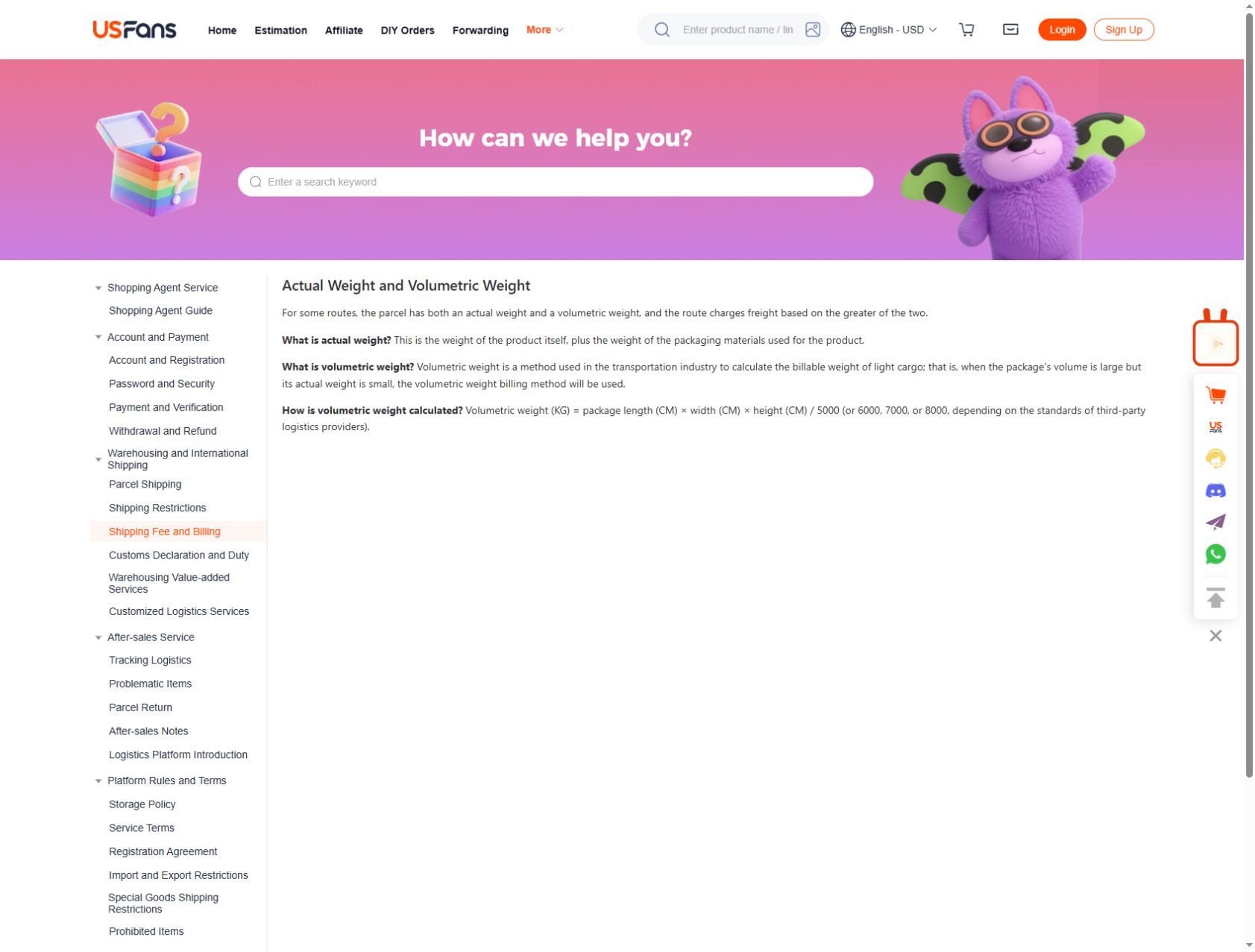
USFans' weight explanation checked on 30 September 2026 defines actual weight as the goods plus packaging. Some routes compare that with volumetric weight and charge using the larger. The volume calculation divides length × width × height in centimetres by the logistics provider's divisor; the policy examples include 5,000, 6,000, 7,000 and 8,000.
The important qualification is “some routes.” Do not apply a divisor or a larger-of-two rule to every service without checking its terms. Nor should you substitute the bare product weight for the packed parcel simply because that is the only number currently visible.
Work through the volume before assuming a price
Consider a hypothetical parcel measuring 45 × 32 × 25 cm and weighing 4.5 kg when packed. These numbers illustrate the method; they are not a recorded USFans shipment or a quote.
The volume is 45 × 32 × 25 = 36,000 cm³. Dividing by 6,000 gives 6 kg; dividing by 5,000 gives 7.2 kg. If a particular service applies the larger-of-actual-and-volumetric rule, its starting weight basis would therefore differ with the divisor.
Swipe sideways to see all columns
| Illustrative rule | Actual weight | Calculated volume weight | Larger value |
|---|---|---|---|
| Divisor 6,000 | 4.5 kg | 6 kg | 6 kg |
| Divisor 5,000 | 4.5 kg | 7.2 kg | 7.2 kg |
Neither row establishes the price. You still need that service's tariff and any rounding or charge conditions it applies. The example explains why the same physical parcel can produce different weight inputs without either calculation necessarily being wrong.
Compare packaging scenarios honestly
Suppose, purely for illustration, that the same hypothetical contents could be packed at a height of 20 cm rather than 25 cm. The volume would become 28,800 cm³. With a divisor of 6,000, that corresponds to 4.8 kg before considering the service's other rules.
That arithmetic is not proof that your parcel can be made smaller, that the packed weight will remain unchanged or that reducing packaging is appropriate. Do not sacrifice necessary protection merely to reproduce a numerical example. Ask what packing options are actually possible for the contents and compare the resulting measurements.
A bag is one product where external dimensions and packaging can matter to the parcel discussion:
Inspect the black-and-pink backpack candidate on OG
This listing is not a measured parcel or a route-acceptance confirmation. No dimensions in the worked example are assigned to that product. Check the selected item and actual packing information separately.
Hold the parcel constant when comparing services
Once you have the input set, compare services using those same inputs. Record the weight basis alongside each result instead of retaining only the amount. A lower displayed figure is difficult to interpret if its calculation assumes different dimensions or excludes a selected service.
Identify what the displayed amount includes. Keep merchandise cost, shipping and any separately identified charges distinct. A currency display change does not turn a shipping estimate into a complete purchase total.
If you change the contents to make a service appear cheaper, repeat the calculation for the other candidate services too. Otherwise you have compared two parcels, not two ways of shipping the same parcel.
Read the timing separately from the price
A quoted time window may describe a different period from the one you care about. Determine whether it refers to a transport stage and whether earlier handling is included. Do not add an invented warehouse duration to create a promised arrival date.
The delivery-time guide separates the events used to describe elapsed time. Once a parcel moves, use its actual events in the tracking guide rather than treating the original estimate as evidence of its current location.
Why an estimate and a later amount can differ
First check what changed: the packed measurements, destination, selected service, contents or extras. If the inputs appear identical, ask which line or calculation accounts for the difference. Do not infer a cause simply because the total increased.
A useful support question includes both input sets and identifies the discrepancy. Avoid publishing private recipient details when seeking general advice. The support guide helps structure a request, and the payments guide distinguishes an estimate from an authorised transaction.
Refresh at the point of decision
Repeat the check after meaningful parcel changes and before committing to the selected service. Keep the resulting record with the parcel it concerns. A saved estimate for an earlier combination of goods is background information, not the current amount for a different shipment.
If you still lack a critical measurement or a clear explanation of the charge basis, resolve that uncertainty before treating the result as a budget you can rely on. The purchase guide connects this step with the earlier product decision.
Common questions
Can I calculate shipping from the product weight alone?
It may be an initial input, but it does not describe packaging or volume. Use the information required by the relevant service and distinguish tentative inputs from a packed measurement.
Is 6,000 always the correct divisor?
No. The published explanation gives several provider-dependent examples. Check the actual route standard rather than choosing the divisor that produces the lowest figure.
Does a lower billable weight always mean a cheaper service?
Not across different tariffs. Compare the resulting amount and its conditions for the same parcel, not just one component of the calculation.
Is consolidation always cheaper?
No universal saving follows from combining items. Compare the actual available parcel configurations and service conditions before making that claim.
USFans Shipping Calculator: Compare Packing Plans Before Comparing Prices
Before comparing two shipping amounts, check whether they describe the same parcel. A different box size, retained shoe packaging or added item can change the calculation even when the destination stays the same. Keep the inputs visible so you know whether the difference comes from the service or your packing plan.
This is a worked comparison guide, not a live USFans quotation tool. For the basic calculation method, use the shipping calculator guide. Actual prices and available services must come from a proposal for your contents and destination.
A worked example with two packing plans
Imagine two possible arrangements for the same purchase. In this hypothetical example, Plan A weighs 4 kg after packing and measures 40 × 30 × 30 cm. Plan B weighs 4.2 kg and measures 40 × 30 × 20 cm. These are invented inputs for arithmetic, not observed warehouse measurements or a promise that repacking can produce them.
Assume, solely for the comparison, that a service uses a divisor of 6000 and charges according to the greater of actual and volumetric weight before its rounding rules.
Swipe sideways to see all columns
| Calculation | Plan A | Plan B |
|---|---|---|
| Volume | 36,000 cm³ | 24,000 cm³ |
| Volume divided by 6000 | 6 kg | 4 kg |
| Actual packed weight | 4 kg | 4.2 kg |
| Greater value before rounding | 6 kg | 4.2 kg |
Plan B has a slightly higher actual weight yet a lower calculated basis under these assumptions. That does not establish the cheaper final price: minimum charges, rounding and other stated services still matter. It also does not prove that either packing arrangement protects the contents adequately.
Change one assumption and check again
If a different service uses a divisor of 5000, the same dimensions produce 7.2 kg for Plan A and 4.8 kg for Plan B. Both exceed their respective actual weights. You cannot carry the 6 kg and 4.2 kg results into that comparison unchanged.
The USFans weight explanation checked on 30 September 2026 ties the divisor to the logistics provider and describes greater-of-two charging for some routes. Apply the selected service's rule, including any rounding or weight increments, rather than importing the lower result from a different proposal.
The lesson is to preserve the input set, not to memorise one divisor. If a result changes, you should be able to say which dimension, weight or service rule changed with it.
Do not trade necessary protection for an attractive number
Ask what a packing change involves. Removing an outer box, changing protective material and combining goods are different actions. A smaller parcel can fail your purpose if it leaves a fragile item inadequately protected or removes presentation you wanted to keep.
For example, you can inspect the Adidas Superstar product page on OG while planning footwear purchases. That page does not establish the packed dimensions of your order. If retaining a shoe box matters to you, include that requirement in the packing enquiry rather than assuming every quote includes it.
Keep a quote comparison on one basis
For each available proposal, retain the destination, contents, packed measurements, chargeable-weight rule and quoted amount. Keep currency and explicitly included services with the amount. An unexplained blank is not a zero-cost item.
Compare timing separately from money. A transport estimate may start at a different stage from your own purchase deadline; the delivery-time guide explains the distinction. Do not select a supposedly faster proposal without knowing what period its estimate describes.
If one proposal concerns the finished parcel and another uses estimated dimensions, mark that difference in your own notes. The two amounts are not equally settled just because they appear in similar boxes on a screen.
What to ask when the final amount differs
Request a comparison of the earlier inputs with the packed parcel: actual weight, dimensions, selected service and added services. This is more useful than asking why the price changed without identifying the earlier estimate.
Keep the response with the relevant parcel record. Do not infer a hidden charge or a guaranteed refund merely from a difference between two amounts. The support guide helps frame the question, while the shipping guide covers the wider parcel decision.
Return to the USFans Spreadsheet collection for product discovery. Keep the calculation tied to the parcel it describes rather than attaching one transport amount to every item in the list.