
USFans Delivery Time: Start the Clock at the Right Event
“How long does USFans take?” needs a starting point. The time from paying for a product to receiving it is not the same as the time from international dispatch to delivery. A short answer that mixes those periods can lead you to expect a parcel before the goods have even reached the warehouse.
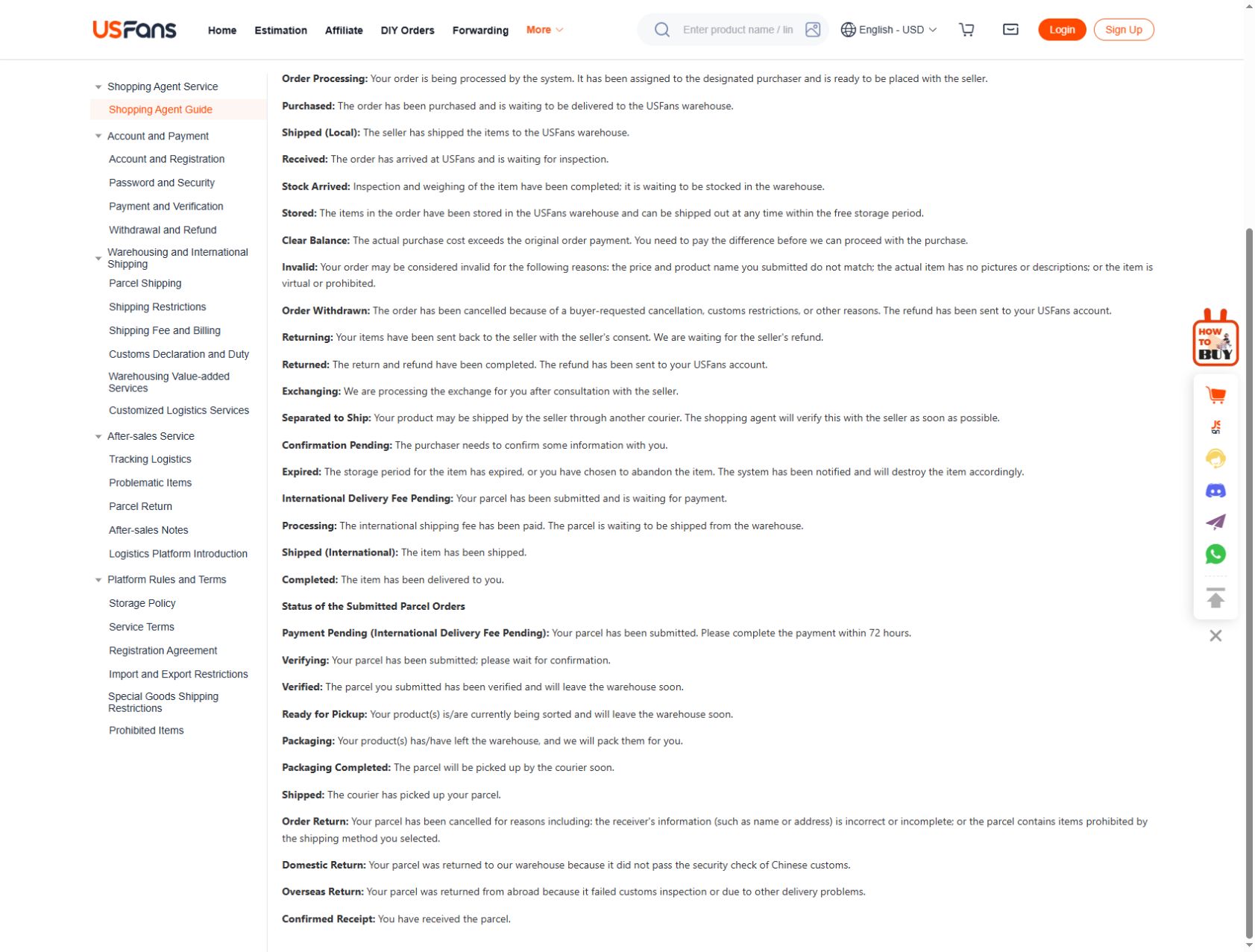
Use the events for your actual order to locate the stage you are in. Then compare the relevant estimate or ask about that stage. This guide does not supply a universal arrival window for every destination or shipping service.
On this page
Separate the product journey from the parcel journey
USFans' published first-time instructions describe purchasing goods and moving them to the warehouse before the later international parcel stage. A product payment therefore should not automatically become the starting date of an international transport estimate.
Record the important events separately: product ordered, warehouse arrival, parcel submitted, dispatch or carrier acceptance as recorded, and delivery. Not every system will use those exact labels. Read what the displayed event actually describes rather than forcing it into a guessed timeline.
The purchase guide explains the sequence. If you are waiting for the product before creating a parcel, the order-status guide is more relevant than a discussion of international transit.
An example of two accurate but different durations
Imagine an order paid on 1 October, arriving at a warehouse on 6 October, with a parcel submitted on 8 October, a recorded carrier handover on 10 October and delivery on 20 October. These are invented dates to explain the clocks, not a USFans case or performance estimate.
The payment-to-delivery interval is 19 elapsed days. The handover-to-delivery interval is 10 elapsed days. Calling both “shipping took ten days” would erase nine days from the full purchase timeline, even though the transport-stage description could be accurate.
| Question | Events to compare in the illustration |
|---|---|
| How long did the whole purchase take? | 1 October payment to 20 October delivery |
| How long before the goods reached the warehouse? | 1 October payment to 6 October arrival |
| How long after the recorded carrier handover? | 10 October handover to 20 October delivery |
This is elapsed calendar arithmetic, not a claim about inclusive counting or a service's business-day rules. Establish the convention attached to an actual quoted estimate before comparing it with your own calculation.
Read the estimate's boundaries
When selecting a service, ask what starts and ends its stated window. Does it refer to the whole period you care about, or only part of the transport? If handling or another stage is not described, do not fill it with an invented fixed duration.
Also retain the destination and service alongside the estimate. A timing report for another country or an unidentified route may describe a genuine experience without predicting yours. The shipping guide helps keep the service choice attached to the parcel information.
An estimate is not the same as a guaranteed delivery commitment. Read the actual conditions before treating it as one, particularly if you need the goods for an event on a fixed date.
When tracking is quiet
USFans' retained help text on tracking updates describes gaps around early scans on some routes. That supports a narrow point: visible tracking activity can differ between stages and routes. It does not establish a universal waiting period or confirm that a particular silent parcel is progressing normally.
Look at the last event, its date and the parcel it belongs to. Has a carrier recorded acceptance, or is the visible information still an earlier status? A tracking reference by itself should not be treated as proof of every later movement.
Use the tracking guide to interpret the record. If you ask for assistance, provide the actual wording privately rather than summarising everything as “stuck.” A precise description makes it easier to identify what needs clarification.
Find the uncertainty instead of inventing a delay cause
If the goods are not yet in the warehouse, ask about the product order. If the parcel has been prepared but the next movement is unclear, ask about the parcel handover. If a carrier has recorded an exception, ask about that recorded exception rather than guessing from a social-media story.
Do not conclude that customs, a missed flight or warehouse congestion caused a gap unless there is relevant information supporting that explanation. Such guesses may sound helpful while sending you to the wrong next action.
The support guide helps structure an inquiry around the reference, last event and question. Keep your full address and other identifying details out of public discussions.
Timing can affect the product decision
Suppose you are considering a jersey for a particular match day. An attractive candidate and a general delivery anecdote are not enough to establish that it will arrive in time. Resolve the actual timing question before relying on it for that date.
Examine the Argentina home-jersey candidate on OG
This is a product to inspect, not a verified in-stock offer or a delivery commitment. No date in the worked example belongs to this listing. If arrival by a particular day is essential and cannot be established, do not treat a hopeful estimate as a confirmed plan.
The jersey guide covers selection questions separately. Product suitability and arrival timing must both support your decision; one cannot replace the other.
Keep cost and speed comparisons consistent
A cheaper service and a faster-looking estimate may describe different assumptions or conditions. Compare services using the same parcel and destination, and retain the quoted time basis along with the price. The shipping calculator guide explains the input side of that comparison.
Adding protection does not by itself make transport faster or guarantee arrival for an event. The insurance guide addresses conditions of protection, not a universal acceleration service.
After delivery, describe the experience accurately
If you share your own timeline, identify the events you used and the destination at an appropriate level of detail. Avoid publishing private labels or tracking identifiers. Distinguish a completed delivery from an estimate you received earlier.
When the process included a question or a delay, include the eventual outcome if known. That makes the account more useful than posting a final duration without explaining which period it covers.
Common questions
Can I count from the day I first paid?
Yes, if you are measuring your whole purchase experience and label it that way. Do not compare it directly with a quoted transport-only interval without accounting for the different starting event.
Does no tracking update prove a parcel is lost?
No. It means the visible record has not supplied another event. Establish the relevant parcel status through the appropriate channel rather than inferring either loss or normal progress from silence alone.
Should I copy another buyer's delivery estimate?
Use their account as context only. Confirm the service, destination, period and events before judging how comparable it is; it is not a quote for your parcel.
What should I ask when an expected date passes?
Ask about the actual last event and the next action for your parcel. Check applicable inquiry conditions rather than waiting for an arbitrary number of days taken from another route.